
It is mid-January. The snow is thawing. Holiday decorations are getting cleared away. And what about your New Year’s resolutions?
If you are struggling, do not give up hope just yet. You can gain clarity about your situation by reflecting on the right questions. The following seven questions allow you to re-evaluate any personal or professional goal at any time of year.
In this series of posts, I offer you thought-provoking questions, insights and methods that will help you to:
- Compassionately and intentionally choose the goals that are right for you.
- Phrase your goals as positive actions, rather than ideas or non-actions.
- Manage your goals with tools and strategies.
Table of Contents
- Summary
- #1: Mindful Self-Compassion: Explore your feelings about the goal.
- #2: SMART goals: Recognise the difference between the RESULT and the PROCESS of reaching the goal.
- #3: Extrinsic and Intrinsic Motivation.
Summary
You can re-evaluate your goals using mindful self-compassion, the SMART method and the source of your motivation. This post is a guide to exploring your feelings, recognising the difference between process and result and clarifying your motivations.
The seven questions for self-reflection and goal setting are:
- How do I physically and emotionally feel about the goal?
- Why do I want to get to that result?
- What is the process of getting to that result?
- Why do I want to follow that process?
- Is it a SMART goal?
- Are my motivations extrinsic, intrinsic, or both?
- How can I find and protect my intrinsic motivation?
#1: Mindful Self-Compassion: Explore your feelings about the goal.
The following three questions allow you to determine if you have chosen the right goal.
The first question to ask yourself about your goal is: How do you feel about your goal?
Be honest with yourself. Don’t overthink it, feel it. Asking yourself the question is already valuable in itself. Just let the answer come to you.
What do you physically and emotionally feel when you think about your goal? Some possible answers might be: heaviness, lightness, eagerness, excitement, anxiety, tiredness, resentment, confusion, inadequacy, demotivation, etc.
If you feel bad about your goal, please be compassionate with yourself. I can sincerely recommend the following mindful self-compassion practices to you:
- Compassionate touch:
- Putting your hand on your heart.
- Holding your head or face in your hands.
- Containment hug.
- Loving kindness wishes:
- “May I be well. May I be safe. May I live with ease. May I begin to feel peaceful.”
- Speaking to yourself with self-kindness:
- “These goals do not define my worth as a person. I already have enough, I already do enough and I already am enough. Right now.”
#2: SMART goals: Recognise the difference between the RESULT and the PROCESS of reaching the goal.
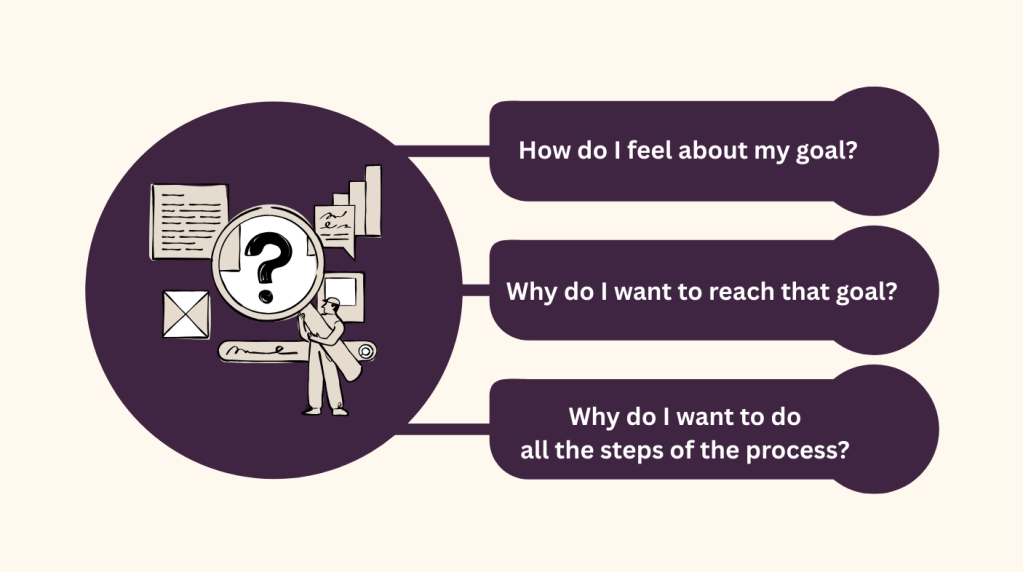
After exploring your feelings, you might want to explore your motivations next. You can find examples for types of motivation under “Extrinsic and Intrinsic Motivation”. The question is: Why do you want to do it?
This question can be divided into two:
- Why do you want to reach that result?
- Why are you willing to do the steps that are required in the process of getting to that result?
A common mistake is formulating your goal as nothing but a desired outcome. For example: “I want to sleep eight hours a night” or “I want to win a boxing match”. The phrases are lacking in direction. The process of taking steps into the direction of these results is forgotten.
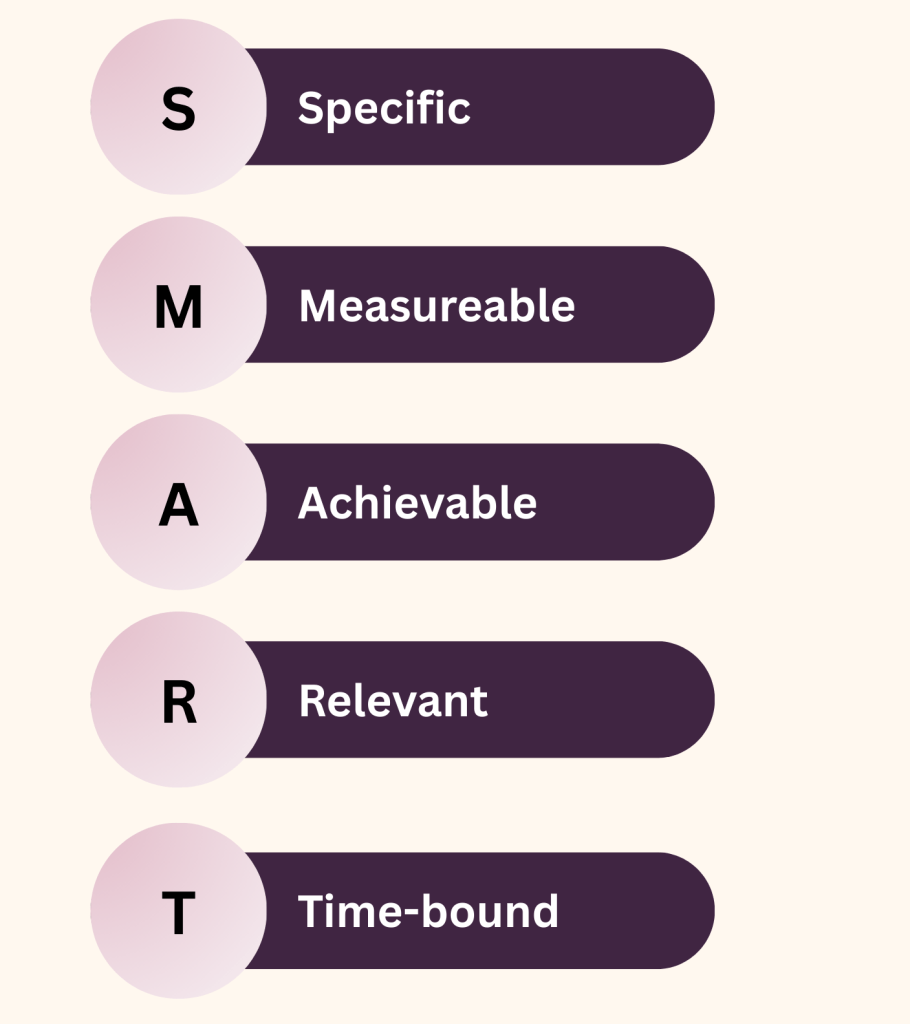
Consider which actions you are going to take in order to get to those results. Then, rephrase your goal in a SMART way. The SMART method states that a goal should be specific, measurable, attainable, relevant and time-bound.
For example:
“I will follow a bedtime routine, go to bed earlier (increasing by 30 minutes per week over the next 3 weeks) and set an alarm in order to sleep eight hours a night.”
“I will do three training sessions per week for six months in order to win a boxing match.”
The hard truth is this: The results may be fleeting. If your goal is to win an award, it is likely that the process of getting to that result will make up more than 99% of the experience. The actual award ceremony is going to account for less than 1%. Are you willing to spend years doing a certain activity or mastering a skill in order to experience three hours of glory?
This goes to show that the results are very different from the process. What motivates you to pursue both the result AND the process? There are different types of ways to reach a goal. Commonly, the process includes: writing the goal down, making a plan, finding the required resources (time, energy, etc.), taking action every day, overcoming obstacles and reflecting on the progress.
If you are struggling with these questions and feel resistance towards the results or the process, it is time to re-evaluate that goal. The goal has to feel right to you. Do you feel good about your goal? Is it a SMART goal?
If the mere thought of it fills you with resistance, bitterness or heaviness, it might be the wrong project for you to take on right now. Perhaps, all that is needed for you to feel more confident and optimistic about your goal is for it to be rephrased. I will provide methods and tools for you to rephrase your goals in the next post.
If you don’t love it, change it or leave it.
Society presents you with hundreds of admirable life goals, but you don’t have to say yes to every goal. Choose the goals that are right for you. Choose the few that really matter to you based on your values and motivations.
#3: Extrinsic and Intrinsic Motivation.
Your motivations might be extrinsic or intrinsic. Extrinsic factors are influences that stem from your environment. In contrast, intrinsic factors are positive experiences that happen in the process of doing an activity. This grid illustrates the most common extrinsic and intrinsic factors of motivation:
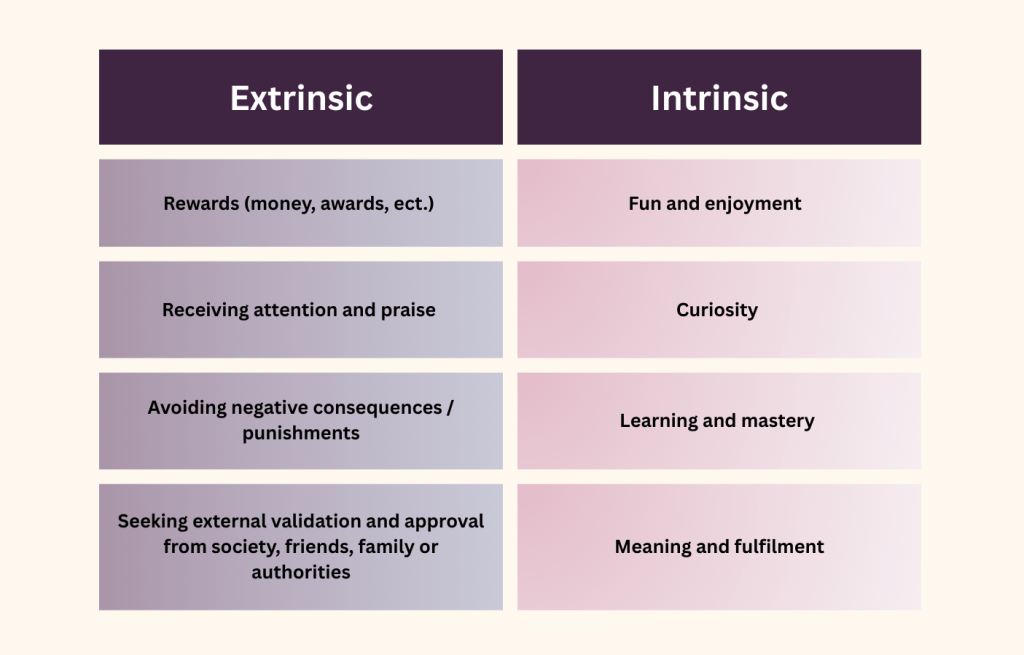
By now, you might have some clarity about the source of your motivation. Extrinsic factors are dependent on your environment. Therefore, they are beyond your control. Setting a goal with the intention of receiving these rewards from others provides the illusion of control, but in reality, there is no guarantee that you will receive the expected rewards, even after you follow the process of reaching your goal.
Intrinsic factors reward you in the process. If you enjoyed learning about a new interest or mastering a new skill, no one can rob you of your personal sense of happiness and fulfilment. If you had fun doing an activity, no one can take that away from you — as long as you do not let the feelings, expectations and words of haters bring you down. Do not let them steal your joy.
My final remark about this concept is a warning: Do not allow your intrinsic motivations to be corrupted by extrinsic motivations!
Imagine this:
At first, you spend time on an activity because you just feel like doing it. It is fun! It is enjoyable! You love it! Then, something changes. Perhaps you start pursuing that activity as a form of paid work. Perhaps your efforts are seen by lots of people that are eager to give you feedback (both good and bad). Your feelings toward that activity change and turn negative. Suddenly, your intrinsic motivation is corrupted by extrinsic factors such as fees, time pressure, compliments and criticism.
In conclusion, you can use the described seven questions to find out whether you have set a suitable goal. Through the practice of mindful self-compassion, the SMART method and protecting the source of your motivation, the process of pursuing a goal becomes easier and more sustainable in the long-term.
In the next post, I will provide you with new concepts that help you to change and rephrase your goals. Read it to find out more about the Comfort Zone, the Wheel of Life and the If-Then-Trap.
If you share my passion for personal development, feel free to write me an email or read more about me and my work. My blog is about various topics, such as books, travel and personal development. I am offering you inspiration and information for your reading journey and daily life. Do not miss out on my future blog posts and book reviews! They will include fiction and non-fiction books, recommendations, guides, advice, success stories and useful examples that will help you to create the daily life of your dreams.
Let’s discuss in the comments or per email: What is your personal experience with goal setting? What are your thoughts on this blog post? Do you have any questions, wishes or feedback? Let’s connect!

 Julia Radi